Showing posts with label jeffrey veen. Show all posts

Saturday, November 11, 2006

Making The Most of Yourself

As an aspiring freelancer, soon to be cast adrift from corporate life, I've obviously been taking all opportunities to get advice on promoting my services and attracting clients. Three great posts have come to light in the past couple of weeks:

  • First up, Andy Budd lists 7 Habits of a Highly Successful Freelance Web Designer - some great tips, and ones I shall be keeping in mind for my own career development.
  • Andy also raises some interesting questions in his Blogging For Business and Pleasure article. One way to raise your profile in the web sphere is to blog regularly, and whilst it might not attract huge numbers of clients beating down your door (depending on their tech-savvy research), it can certainly pay dividends in terms of securing freelance work with other design companies, for instance. Andy employs freelancers on a regular basis, and says:
    By building your reputation as an expert, people will be happy using your services and recommending you to others. Blogging is a particularly good way of doing this and is something I highly recommend. When looking for a new freelancer I’ll get a much better sense of their interests and abilities though their blog than I’d ever get from reading a resume.
  • One of Andy's recommendations is to get a killer portfolio. On this theme, Jeff Veen gives us Five Steps to a Better Design Portfolio. Again, lots of good advice from people that have been there and done it (and done it very well).
Back to the networking theme...
I've just attened a two-day workshop, run by Penna, which helps people with their career transitions - what a nice way of saying "redundancy", LOL. One statistic to come out of that was the fact that only 10-20% of new appointments are actually filled via advertised recruitment - the rest come from personal recommendations or individuals targeting the right people with their resumes. I was really surprised by how low that figure was, but our course leader pointed out that most people will spend their energies concentrating on this 20% and completely ignore the other 80% of, albeit hidden, opportunities.

Networking in a formal, business sort of environment has always struck me as particularly dull, but I've had a great time at recent geek events, chatting over a beer, and getting to know people. Now that sort of networking, I could really get to enjoy!

And of course, it's not a case of bounding up to people and saying "gizza job!" - oh, no. The seeds might be planted now, but the rewards might not be reaped for months or even years. It's a long term bet, but one in which it's well worth investing.

Friday, September 08, 2006

d.construct, Designing The Complete User Experience

A presentation by Jeffrey Veen

[Jeffrey Veen gets excited talking about his old job at wired.com]

Jeff Veen's presentation where to start? He's a very charismatic and engaging speaker, and this was no exception. You can download his presentation slides from his website. But here are a few bulletpoints.

Three criteria you should think about before producing a site:

  • Viability - business case and reasons for building a site
  • Feasability - can it be done?
  • Desirability - do people want it?
[The best products are the most desirable]

Your site's architecture and structure should always be extensible. Even if you start small, plan for expansion! Otherwise...

[What could happen to Amazon by the year 2050...]

Design faces global challenges, but even at a local level, terminology can vary widly. In the US, a survey was conducted to see what people asked for when ordering a fizzy drink. The results were pretty mind-boggling!

[I'd like a can of coke/soda/pop/other (delete as appropriate)]

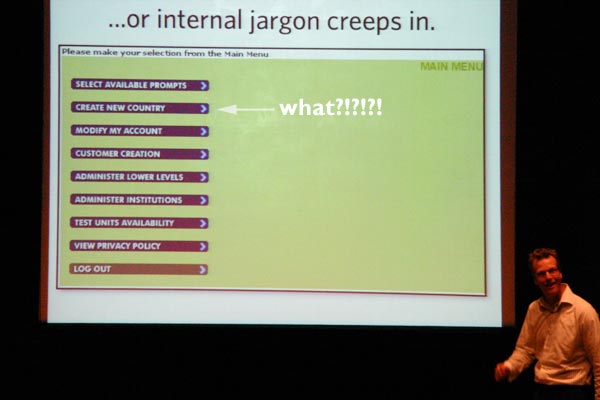
Terminology can be important when labelling application functions. What happens when internal jargon creeps in - or is it megalomania taking over?

[Create New Country?!?!!]

Understanding Your Visitors is a crucial step in putting together a useful, usable website. Using simple stickie notes to group together functions vs what users are trying to achieve (card sorting) can show up gaps in both directions:

[Mind The Gap mapping]

Top half maps user tasks and bottom half maps website features - the trick is not to have gaps either way. No point wasting resources engineering something that nobody wants, but completely ignoring a facet of the site that is not currently available but users are crying out for.

Finally, Jeff pointed out that it's much more expensive to change your mind (add new features) the closer you get to launch. Proper user research means you are not wasting time, money and resources by going up the wrong garden path.

Friday, June 16, 2006

@media, Designing Next Generation Web Apps

Jeffery Veen's discussion, mainly covering what's called Web2.0 applications. The elements are:

Surface (typography, layout, colour, grid - skin), Skeleton (web application interactions, page elements - "what can I poke?"), Structure (information architecture and hierarchy), Scope ("what can I do now?") & Strategy (what do we actually do).

  • Surface
    Try to make users feel in control - example was the rainfall map with a month slider, which then interactively showed rainfall as a progressively bigger raindrop - much easier to comprehend than a table full of dry [sic] figures for rainfall per month! Trust users as peers. Trust of the surface presentation can help to foster trust of underlying data: it can influence visual appeal, cognition and emotion and increas the halo effect (credibility -> users trust data and content if they trust the visual design).
    References: Don Norman, Emotional Design; BJ Fogg, Persuasive Technology
  • Skeleton
    The design process: Whiteboard/fag packet! -> wireframes -> AJAX layout
    Ref: www.kayak.com - search results page.
    Ajax interaction & design:
    • Discoverability - how easy is it to find stuff? - give gentle hints like auto-complete search box
    • Recoverability - catch errors before they occur (form validation etc)
    • Context - real-time feedback to compensate for poor browser interface (eg proper progress bar for file uploads etc)
    • Feedback - how the system behaves, and the states of pages.
  • Structure
    For a site like del.icio.us, tagging forms the "experience" as the system architecture. Similarly Flickr - tag your images and then use these to pivot on your metadata, to find others with similar tags. Builds communities of people with common interests. This breaks down the old style rigid hierarchical structure - no one can actually draw a sitemap for Flickr!
  • Scope
    Scope is more focussed than before; we still have some of the old problems on a new platform, but now with added participation.
    Apparently, 60-70% of CMS's fail!
    For some functions, a blog such as Type Pad with a bit of custom design would be more than sufficient for eg Press Releases - whereas a CMS would perhaps be overkill.
    Ref: The Hype Machine - go look
    Also allowing stuff like the GoogleMaps API into the hands of the right dedicated people can lead to much more effective and localised sites such as chicagocrime.org
    Similarly Measuremap - a stats engine - is open source. Your site is just one piece of a larger whole.
  • Strategy
    How is the audience changing?
    Dedicated amateurs can now provide rich content - amateurisation is the "architecture
    of participation".
    Travel booking sites - travel agents have virtually gone away. A huge majority of people now book travel online.
    Wikipedia - how to deal with user interactions etc.
    Furl - your personal web file.